Showing posts with label creating characters. Show all posts

Tuesday, 3 May 2016

I Need a Hero

This week I'm talking about the kind of hero I love to write.  

When I first began writing, my heroes were always tall, dark-haired, blue-eyed and had a good sense of humour - mainly because I was married to a man who is tall, dark-haired, blue-eyed and has a good sense of humour - and I still am! But I soon realised it's not such a great idea to try and shoehorn one's husband into every story - he won't always fit. Besides, I would hate to think any of my heroes could be taken out of the environment of their own book and carelessly plonked into another with only a change of name and hair colour. I've worked hard to ensure they all have their own very different flaws, quirks and problems, which is why I love them - and why the basic idea for my stories has to come before I create them (see My Writing Process).

Not me, or my husband, or my house
(which is lucky, as they seem to have a serious case of woodworm)
For example, in my current work-in-progress I wanted to give both hero and heroine a whole heap of trouble relating to their respective (and very eccentric) families. The hero's way of dealing with this is to studiously ignore the fact he even has a problem, whereas the heroine is planning on being a little more proactive - maybe too proactive. And, because I'm evil, obviously all their best efforts to avoid a crisis are about to go horribly wrong. It sounds simple, doesn't it? Characters creating themselves and the story writes itself? The reality is not quite as easy as that.

So what kind of heroes do I like writing best?

I'm very fond of the stranger-comes-to-town-and-is-he-all-he-seems hero (pretty much like any western you've ever watched). Why? Well, think about when you meet someone for the first time, and they tell you their name, and maybe a bit about their job or their family. What if it's all a pack of lies? Or, worse, they're pretending to be someone else entirely?

I also find anti-heroes fun to write, but not necessarily more popular with readers. If obnoxious, he has to have some redeeming qualities or he'll come across as a complete arse - or, in romance terms, an 'alpha-hole'. In Why Do Fools Fall in Love I had two possible heroes (going on the principle of why have one when you can have two): the wise-cracking Luke and the tortured-by-his-horrible-childhood Ross. (Spoiler alert). Guess which one my readers liked best? Luke. And why was that? Because Ross had one (and, as it turned out in the story, almost fatal) flaw: he treated women horribly, including the heroine. And by the time he'd realised his mistake it was too late. So he'll have to put in a lot of work if he wants to find his HEA.

If I have a hero-with-a-tragic-past, like Greg in Breathless, he's got to have a very good reason for the whole brooding mysteriously thing, unless he wants the heroine to mistake his hidden depths for basic sulking. In Greg's case he felt responsible for the death of his sister. Bryn in Nemesis has a similar background but, as his personality is more proactive, he feels he has far more important things to do than stakeout a graveyard and look moody - like solve his cousin's murder.

As most of my books do have a murder to solve, I've had heroes who've been police detectives or investigative journalists. It's easier that way; the police are very picky about who they let walk all over their crime scenes. I also like using characters who are celebrities: Luke in Why Do Fools Fall in Love, Zac in Breathless and the heroes of my Proposal series, because they come with their own (usually self-inflicted) set of problems.

I don't describe a hero's physical appearance much beyond hair and eye colour. This is deliberate. I know what the character looks like inside my head, but I want the reader to do some of the work too. Too much detail from me will read like a 'most wanted' poster. And, by basing a character on a real person - a hot actor, for example - I'd be assuming that because I find a certain type of man attractive, my reader would too. Surely it's better to let them cast their own hero?

The other danger to casting a famous actor as the hero of a novel is that (assuming I've never met him in real life) I'd be reusing the character he is most famous for playing rather than the man himself - a bit like fan fiction. I'd rather be original! And I do my best to ensure my heroes are too.


Perfectly Imperfect (Why rockstars make the best romantic heroes)


Never miss a post! See that little box in the left-hand column, near the top, that says 'Follow by Email'? If you add your email address, you'll receive my latest blog post almost as soon as I've written it.


Photo copyright: Fotolia

Monday, 11 January 2016

Characters: What's in a Name?

In which I talk about how I find names for my characters.    


This blog post was prompted by three conversations I've had with my readers over this past month, about how I name my characters. Two pointed out I'd chosen the same name as one of their relatives (sorry, it's purely coincidental!) another queried why I'd named a character after a dog(!)

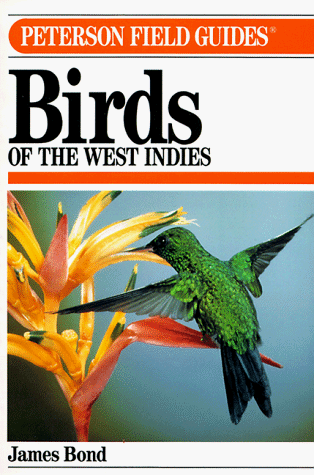
Like most authors, I have a book of baby names (although the only time I've ever used it was when I was trying to choose a name for my own children) but I try not to pick a name at random, even for the minor characters. The name has to mean something. I have more trouble with surnames - they are sometimes chosen at random. Luke McFadden, the hero from Why Do Fools Fall in Love, owes his surname to one of my husband's books on computer programming. I'm not the only author to do this. Ian Fleming took the name of James Bond from a book on birdwatching!

More recently I've been delving into my family tree and borrowing their surnames. Lydia Cavill, the police inspector in Nemesis, who also features in Trust Me I Lie, was the name of one of my several times great-grandmothers. Vines (spelt Vynes in Nemesis) and Groves (Nemesis) are also family surnames. Halfpenny (Breathless) was the surname of a lady I got chatting to in a Jacuzzi!

First names require a little more work. They have to suit the character who has taken up residence inside my head and, for me at least, they have to have some kind of meaning. Sometimes I do cheat - Shelby (Why Do Fools Fall in Love) was just a name I loved - at the time I didn't realise it was also the name of a car designer (and therefore a car!) As Shelby is not the kind of name that occurs very often in the UK, I felt I did have to give a reason for calling her that. So I decided her mother had been a huge fan of Hollywood movies, and gave Shelby three brothers: Harrison, Cary and Irving. As in Harrison Ford, Cary Grant and Irving Berlin (the man who wrote White Christmas).

To Joseph Halfpenny (Breathless) family comes before everything, so I had him name his daughters after his aunts: Phyllis, Selma and Connie - giving them overly 'old-fashioned' names to emphasise the point. (Sorry, if your name is Phyllis, Selma or Connie!) In Nemesis I had a character who was so eccentric she called her three children Summer, Autumn and Wynter, but in the final rewrite she was edited out - leaving me with three siblings called Summer, Autumn and Wynter, and readers perhaps wondering if I was the one who was eccentric.

And the character I named after a dog? Well, that would have been the bodyguard, Bruno, from Why Do Fools Fall in Love. And the idea behind that was that I kind of imagined him to be a human version of a bulldog.

Of course sometimes this method does land me in trouble. In my novella The Indecent Proposal I needed a name for a famous singer, but every time I created one I liked, I found (via Google) there was already a singer with the same name! My creations became sillier and sillier, and still there were singers out there with exactly the same name! Eventually the poor girl ended up being called Destiny Swan. Why is this a problem? Well, for my next book I've decided to use her as one of the main characters. There is no way I'm spending a whole book calling the girl 'Destiny'. She's going to have to be nicknamed 'Desi' - and lump it!

So, how do you choose your characters' names?


Related Posts:


Never miss a post! See that little box in the left-hand column, near the top, that says 'Follow by Email'? If you add your email address, you'll receive my latest blog post almost as soon as I've written it.


Photo copyright: Fotolia

Sunday, 24 May 2015

How I Create Characters

This week's post is a little bit different, because I thought I'd share with you how I create my characters, right from the very first idea ...

I was happily watching a movie last week and heard a really catchy song in the background. Me, being me, I'd Googled it before the credits even had chance to roll and downloaded it. Before I knew it, I had an idea for a story. (You can read more about how music inspires me here).

This is my favourite part of writing - when an idea smacks you right between the eyes and you know you have to go ahead and write it. Of course in three months time I'm going to be muttering about how much I hate the thing, but right now it's the honeymoon period.

Like onions (and ogres!)* characters
should have layers - is the image
presented to the reader the 'real' one?
So I had this idea for a story, which I'm not going to share (because I'm mean like that), and it's about a girl (my books usually are). I already know what she looks like and the kind of clothes she wears and how she spends her time. I know what she wants from her life - or rather, what she thinks she wants - and that's not the same thing at all. She has to have a problem, which she assumes she can solve by running away from it and, because I'm a writer and a complete sadist, she's just going to run into a whole set of new problems, so that will serve her right (mwah haha).

I don't base my characters on celebrities and I don't write long lists of their funny little quirks and what colour their eyes are and what their favourite food is. Somehow I instinctively know all this. Don't ask me how, I just do. I'd rather get on and write a story than compile a list of lists. For example, in Nemesis I knew Alicia's favourite food was chocolate whereas Natalie would think it was a stupid question - and be likely to tell you so as well! I do plan my books, because otherwise I'd get distracted by a subplot, and I always know how my stories are going to end. Although sometimes the identity of the bad guy might change (Nemesis, Something Wicked), and once I even wrote a whole book backwards (Something Wicked).

This photo of a Lewis Carroll quote
was taken in my favourite
coffee shop!
Because my books have a good chunk of romance in them I also need a hero. (Don't we all!) For my new story I've already decided my action is going to take place over the course of a week so it makes more sense for my heroine to already know him. Someone from her past? But why haven't they kept in touch? Ooh, plot development! Now, do I give him a similar set of problems, so their actions mirror each other throughout the story, or set them against each other, give them conflicting goals - and let sparks fly? And all the time I'm thinking 'What if ... ' and if the answer is too obvious, I'll twist it around on its head. I love twists!

It's usually at this point my characters take up residence inside my head and start talking to me. And that's the very best bit. Because when I hear them telling me their story, refusing to act out in the way I want, arguing about how they want to do things, I know I should start writing. Fast.

And I got all this from hearing one song ...


Related Posts:

Music: Wings to the Mind

*If you didn't rcognise that quote, it came from Shrek!

Never miss a post! See that little box in the left-hand column, near the top, that says 'Follow by Email'? If you add your email address, you'll receive my latest blog post almost as soon as I've written it.

Sunday, 18 May 2014

The Appeal of an Imperfect Hero

A tongue-in-cheek look at the heroes of my ‘Proposal’  short story series…

It’s hard to create the perfect romantic hero. He has to have faults and flaws, like any real person, but also have a wide appeal. Now I’ve created heroes who have been detectives, actors, journalists and even a landscape gardener once, but the character I get the most mail about is Taz, the Australian rock star from A Girl’s Best Friend. So why do rock stars make such great heroes?

Well, first there’s all the obvious stuff:

They have talent. Never underestimate the allure of having a song written about you or, better still, sung specifically to you—even if it is on the back of a tour bus somewhere on the M25.

They are hot. Yep, he’s sexy and he knows it.

They know all about having a good time. And we’ve all had that urge to trash a hotel room.

They’re unobtainable. OK, that’s a slight fib. Given the right circumstances, or even the wrong ones, rock stars are not remotely unobtainable.

Everyone else wants them. This, of course, makes us want them even more.

Heroes are supposed to be likeable, preferably lovable and definitely lust-after-able. But despite their apparent good fortune, your average rock star will have a whole host of problems magnified by fame and wealth, many of them self-inflicted, and all of them widely (and gleefully) reported in the media.

In my short story The Indecent Proposal Ryan has been caught cuddling up to a pretty singer at an award ceremony. The photos have been published all over the Internet, so how is he going to get his girlfriend back? In The Accidental Proposal Luca has abandoned his band while on tour—but he’s got a very good reason. Ryan and Luca are both suffering setbacks, not entirely of their own making, but which wouldn’t have happened if they hadn’t been famous.

Musicians work hard but if they’re successful they can have the most amazing, glamorous existence. The Indecent Proposal is set in Sorrento, while The Accidental Proposal takes place in New Orleans. We first meet Ryan at a party, whereas in one of Luca’s early scenes he’s scrabbling about in the gutter. It’s certainly a life of extremes!

Sometimes it’s all too easy to see rock stars exist purely for our entertainment and forget they have their hopes and fears just like the rest of us—albeit on a much larger-than-life scale. They might not be perfect, and I wouldn’t want to date one in real life, but they certainly make fascinating romantic heroes.

Perfectly imperfect, in fact!

Freebie!

You can currently download The Indecent Proposal free of charge from Amazon UK or Amazon USA, as well as other ebook retailers such as Kobo and iTunes, although I can't guarantee it will be free on all sites, as it is up to each company to decide how  much they will charge.

If you have signed up with Amazon for Kindle Unlimited, you can download most of my books as part of your subscription.


Photo Copyright: Shutterstock

Sunday, 6 October 2013

Creating Characters: What's in a Name?

I’ve just read a book (a romance) where the hero was called Trevor. He was described as a tall, dark and very hot twenty-something - but I still kept waiting for him to light a pipe.
 
In the book I’d read before that, the hero’s name was Virgil - and all I could think about was Thunderbirds.

So does it really matter what name an author gives their hero?
 
Why Do Fools Fall in Love
was turned down by the first publisher it was sent to. The most random reason was that the editor didn’t like the names of the heroes - Ross and Luke. “No one is called Ross,” she told me firmly.
 
Obviously not a Friends fan.

When Disney’s Little Mermaid first came out, I remember feeling very let down that the Prince was called Eric. Whoever heard of a hero called Eric? Ah … Well, if you’ve ever watched True Blood, or read the Charlaine Harris books the TV series is based on, you’ll be familiar with a vampire called Eric Northman. His name suits him fine - mainly because he’s also a 1,000 year old Viking.

In Breathless, Joseph Halfpenny’s daughters have been given the old-fashioned names of Phyllis, Selma and Constance. The Halfpennys are big on both family and history so I had the idea that Joseph named them after his mother and aunts.
 
So the moral of this story is that authors should have the freedom to call their characters whatever they like, even ‘Trevor’.
 
But they’d better have a very good reason.